The Transparency Paradox: Defying the 7-Star Energy Crunch
Why complying with NCC 2022 shouldn't cost you the view.
A floor-to-ceiling window is a promise of freedom. To the architect, it is a canvas of light; to the homeowner, a connection to the horizon.
But under Australia's new National Construction Code (NCC 2022), that view has become a liability. The mandatory shift to a 7-Star energy rating has placed immense pressure on building design. To satisfy energy modeling software like NatHERS, the path of least resistance is often to drastically reduce the Window-to-Wall Ratio. We call this the "Porthole Problem"—luxury homes designed with disappointingly small apertures, sacrificing the very views the land was purchased for, simply to tick a compliance box.
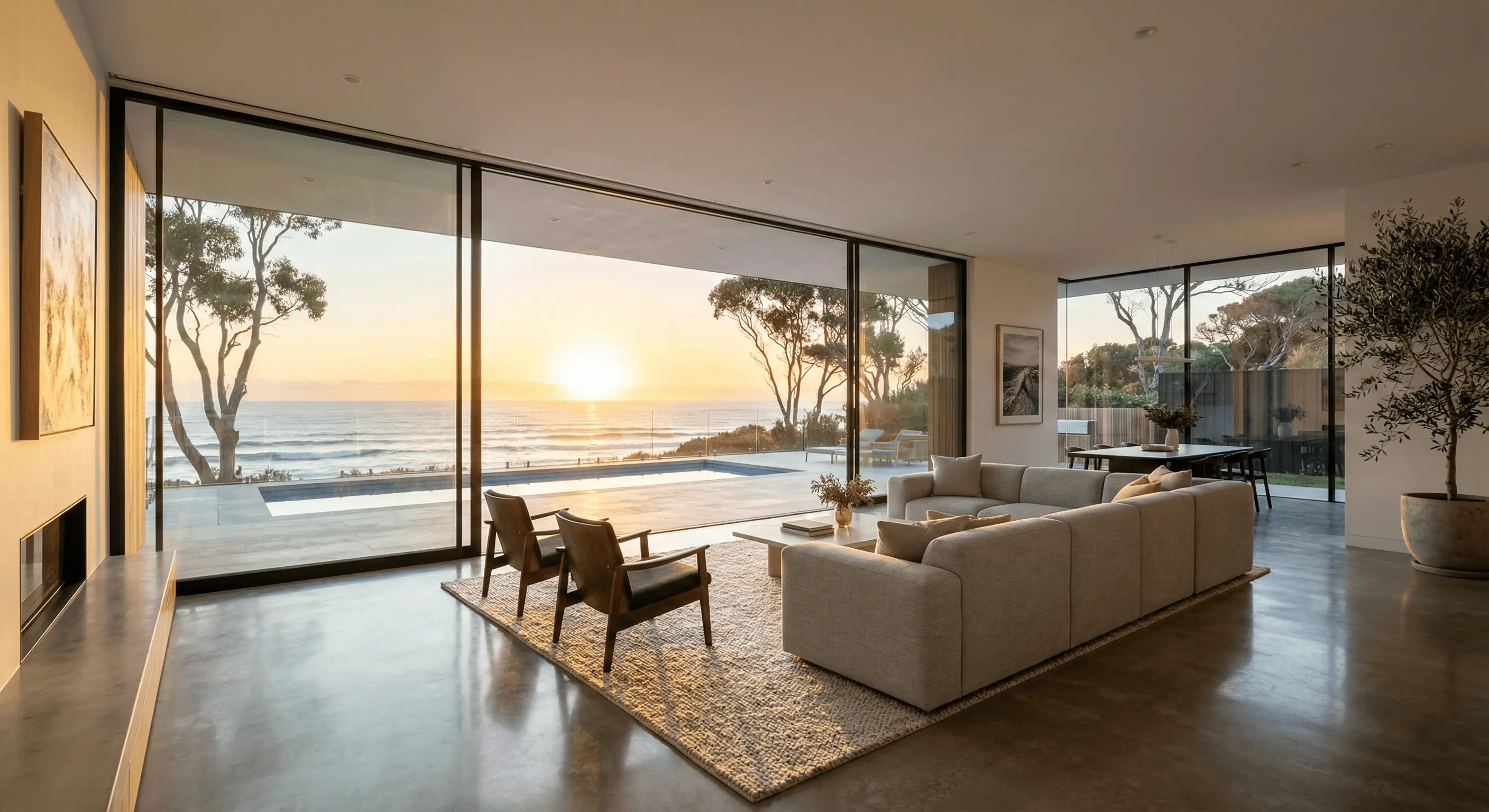
1. The Challenge: The "Porthole" Reality
The mathematics of the new code are unforgiving. Standard aluminum windows act as thermal bridges, bleeding heat in winter and admitting solar radiation in summer.
Standard single-glazed aluminum delivers a U-Value of roughly 6.0, failing the 7-Star requirement instantly. Even standard double glazing often hovers around 3.0, which is frequently insufficient for massive architectural spans.
2. The Innovation: The Suspended Barrier
To defeat the Porthole Problem, we did not just add more glass. We changed the internal atmosphere of the window unit.
Leveraging our proprietary Suspended Film Techbology, we replace the heavy, optical-distorting third pane of glass found in traditional triple glazing with a weightless, invisible PET membrane.
-
The Science: By suspending a specialized anti-UV film between two panes of Low-E glass, we create multiple insulation chambers. This structure severs the thermal bridge, stopping heat transfer dead in its tracks.
-
The Result: We achieve U-Values as low as 0.5 W/m²·K, transforming a glass wall into a thermal barrier comparable to an insulated solid wall.
3. The Metrics: Understanding the Invisible
To beat the system and keep your views, one must master the Window Energy Rating Scheme (WERS).The most critical metric is the U-Value (Thermal Conductivity). While the industry struggles to hit 1.5, UltraSlim pushes the boundary to 0.5. Simultaneously, we balance the Solar Heat Gain Coefficient (SHGC) to manage the Australian summer sun without darkening your view.
The Benefit: This implies that you no longer need to shrink your windows to pass Basix. You simply need to upgrade the engineering behind them.

A 7-Star energy rated home is not merely about passing council approval. It is about the luxury of certainty.
Whether you are designing a coastal retreat or a hinterland residence, the requirement for thermal performance should not mean sacrificing the view. With UltraSlim, you can achieve the grand, light-filled home you envisioned, resting easy knowing you are utilizing a system engineered to meet rigorous international standards.